 Shop All
 Food Containers
 Cookware Sets
 Limited Edition Launches
 Bakeware
 Serveware
 Corporate Gifting


Understanding different types of knives is not a luxury reserved for Michelin-starred chefs; it is a fundamental necessity for anyone who cooks. Yet, the average kitchen operates on an inefficient habit, relying on one blunt blade to do everything. It is a mistake. You bruise the vegetable, you shred the meat, and you ruin the dish before it even hits the heat.
The solution is discipline—matching specific knife uses to the proper kinds of kitchen knives. It is pure mechanics. A curved blade is engineered to rock through heavy, prep-heavy ingredients effortlessly. A flat Japanese edge is designed to push-cut with absolute precision. By choosing high-carbon stainless steel, you ensure the blade retains its razor edge, giving you clean, consistent cuts every single time without losing its sharpness.
Master this tool-to-ingredient alignment, and the kitchen chaos vanishes. Your prep time cuts in half, your food cooks uniformly because the pieces are geometrically identical, and you gain absolute control over your cooking. It is that simple. It’s your choice.
Types of kitchen knives: Because the cut decides the taste
Chef's Knife

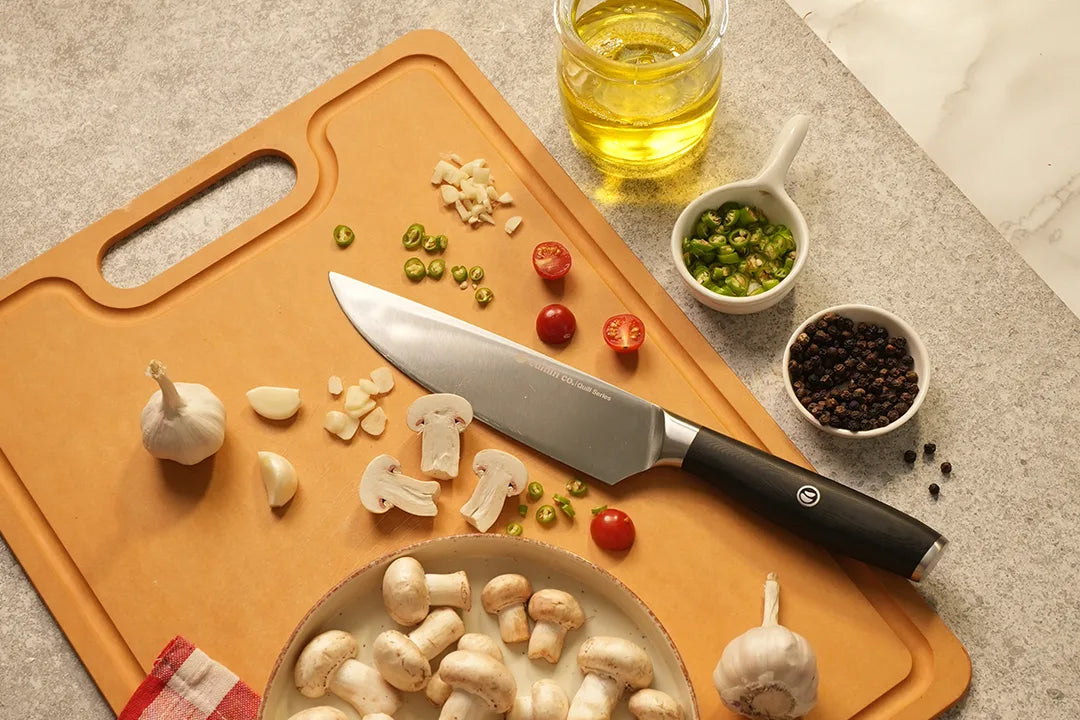
If there is one blade that earns its place in every kitchen, it is the chef's knife. Among all the different types of knives available today, this is the one most professionals reach for first.
Its curved edge is not a design flourish. It exists to create a smooth rocking motion, allowing the blade to travel through ingredients with speed and consistency. When you're processing kilos of onions, herbs, or vegetables, efficiency becomes a matter of geometry.
It is the knife used for slicing, chopping, and mincing. More importantly, it is the knife that establishes rhythm in a kitchen. Master it, and prep becomes considerably faster.
Santoku Knife

The santoku approaches cutting from an entirely different philosophy.
Where a chef's knife favours momentum, the santoku knives favours precision. Its flatter edge is designed for push-cutting—a deliberate motion that produces remarkably clean cuts with very little wasted movement.
This is one of the most popular types of cooking knives for fine vegetable work, thin slicing, and delicate proteins such as fish. When uniformity matters, few blades perform with the same level of discipline.
Utility Knife

Not every task calls for a large blade.
The utility knife exists for the moments where a chef's knife feels excessive and a paring knife feels inadequate. Shorter, narrower, and considerably more agile, it offers a level of control that larger blades simply cannot.
Among the many kinds of kitchen knives, this is often the most underrated. It excels at trimming, refining, and handling ingredients that demand accuracy rather than force.
Steak Knife

A steak knife serves a singular purpose, and it serves it exceptionally well.
Unlike most types of culinary knives, its job begins after the cooking is complete. The blade is engineered to move through cooked protein cleanly, preserving texture rather than tearing through it.
Whether straight-edged or serrated, a good steak knife should glide through meat with minimal resistance. The objective is simple: a clean cut that respects the work that came before it.
Bottomline: Great cooking is born from discipline, and discipline begins with the edge of your blade. Stop compromising your ingredients—choose the right knife, respect the mechanics of the cut, and take absolute control of your kitchen today.
FAQs about kitchen knife uses & styles
What is the difference between chopping and dicing?
Chopping is an informal technique that yields larger, less uniform pieces of food, typically used for long-simmering stocks, stews, or rustic roasts. Dicing is a disciplined, highly accurate technique that requires cutting food into precise, uniform geometric cubes of exact dimensions (such as small, medium, or large dice).
Which knife is best for processing everyday vegetables?
For overall kitchen prep, a standard 8-inch Chef's knife is the most versatile choice due to its curved blade belly, which supports fluid rocking cuts. For fine, intricate vegetable slicing or clean matchstick cuts, a Japanese-style Santoku is superior because its flat edge excels at straight vertical push-cutting.
How do I maintain and improve my knife skills at home?
Stop rushing. Speed is a natural byproduct of clean muscle memory. Slow down and focus entirely on cutting perfectly uniform pieces while maintaining a proper pinch grip and utilizing the protective claw technique on your guiding hand. Most importantly, ensure you are working with a razor-sharp, high-carbon stainless steel blade on a firmly stabilized cutting board.