 Shop All
 Food Containers
 Cookware Sets
 Limited Edition Launches
 Bakeware
 Serveware
 Corporate Gifting


Different methods of cutting vegetables are not mere culinary formalities. They influence texture, flavour development, and cooking time long before your ingredients hit the pan.
Every cut serves a purpose. A fine dice is engineered to melt away into a sauce. A structured baton is designed to endure high heat. A thin slice offers speed and delicacy. The purpose behind these different styles of cutting vegetables is not mere visual appeal. The right cut makes your food cook uniformly, deepens its flavors, and gives you absolute control over your dish.
Overlooking this is why most of us can’t recreate our favorite restaurant’s signature dish. We keep searching for better recipes while the problem secretly lies in the preparation. Uneven cuts lead to uneven cooking, and uneven cooking rarely produces great food.
The solution is understanding how different shapes dictate your ingredient's behavior under thermal pressure. This is where knife skills come into play. Understanding different types of cut in vegetables allows recipes to perform as intended rather than being left to chance.
Because great cooking does not begin with heat. It begins with the cut.
And before mastering the blade, it helps to understand why each cut exists in the first place.
Before you learn the different methods of cutting vegetables, learn to control the blade.
A good grip and proper hand position influence every cut you make. Whether you're slicing onions, dicing carrots or cutting a fine julienne, consistency begins with how you hold the knife.
The pinch grip — professional standard: Do not simply wrap your fingers around the handle. Place your thumb and the side of your index finger directly on the heel of the blade, just forward of the bolster. Wrap the remaining fingers around the handle. This is the grip most chefs rely on. Holding the blade gives you far greater awareness of where the edge is travelling, making every cut feel more deliberate and controlled. Once it becomes second nature, you'll wonder how you ever held a knife any other way.
The handle grip — natural starting point: For many home cooks, this is the grip they learn first. All five fingers wrap around the handle, providing a secure and familiar hold. It may not offer the same level of finesse as a pinch grip, but it's a practical place to build confidence before moving on to more precise knife work.
The claw technique — protect your fingers: The guiding hand should never lie flat on the board. Curl your fingertips inward and allow your knuckles to sit slightly forward. The blade should glide against the knuckles as it cuts. This simple technique is one of the most important knife skills taught in professional kitchens and remains essential across all different cutting styles.
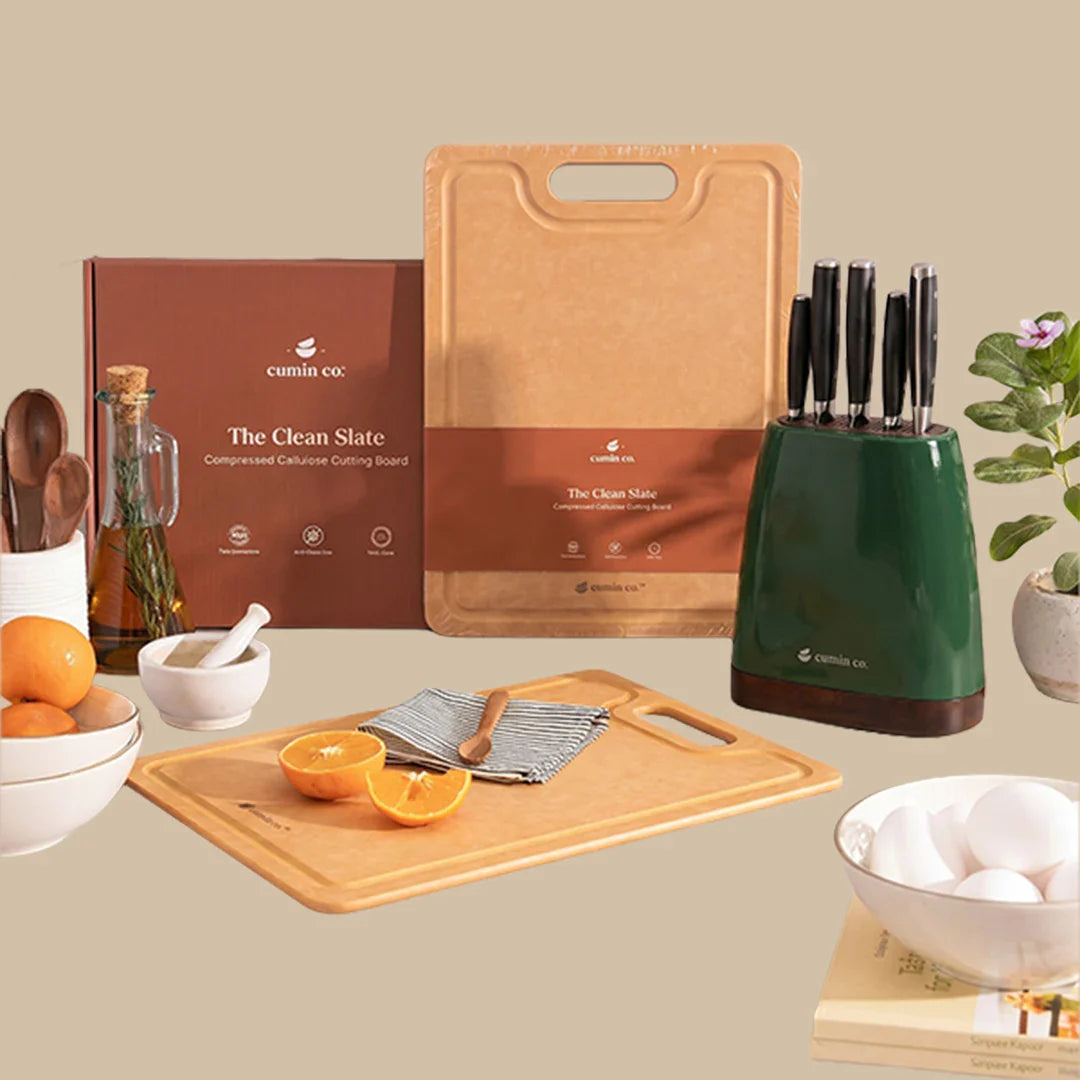
Stabilise your work station: A moving board creates inconsistent cuts and unnecessary risk. Place a damp cloth beneath your cutting board to prevent slipping. When working with round vegetables, create a flat base before cutting. Stability is fundamental to every cutting method vegetable preparation requires, from fine dicing to larger chopping technique applications.
Knife skills and cutting methods
Good knife work isn’t about speed. It’s about control. Once you understand how a blade moves through food, everything else — texture, cook time, even flavour — starts falling into place.
1. Slicing — the base movement (knife skills foundation)
The technique: A steady, flowing motion where the blade moves through the ingredient in one clean path. Push or draw, but never force it.
Best For: Tomatoes, onions, cucumbers, mushrooms.
Why it matters: A proper slice keeps structure intact. A blunt or careless cut crushes the ingredient and you lose moisture before it even hits the pan.
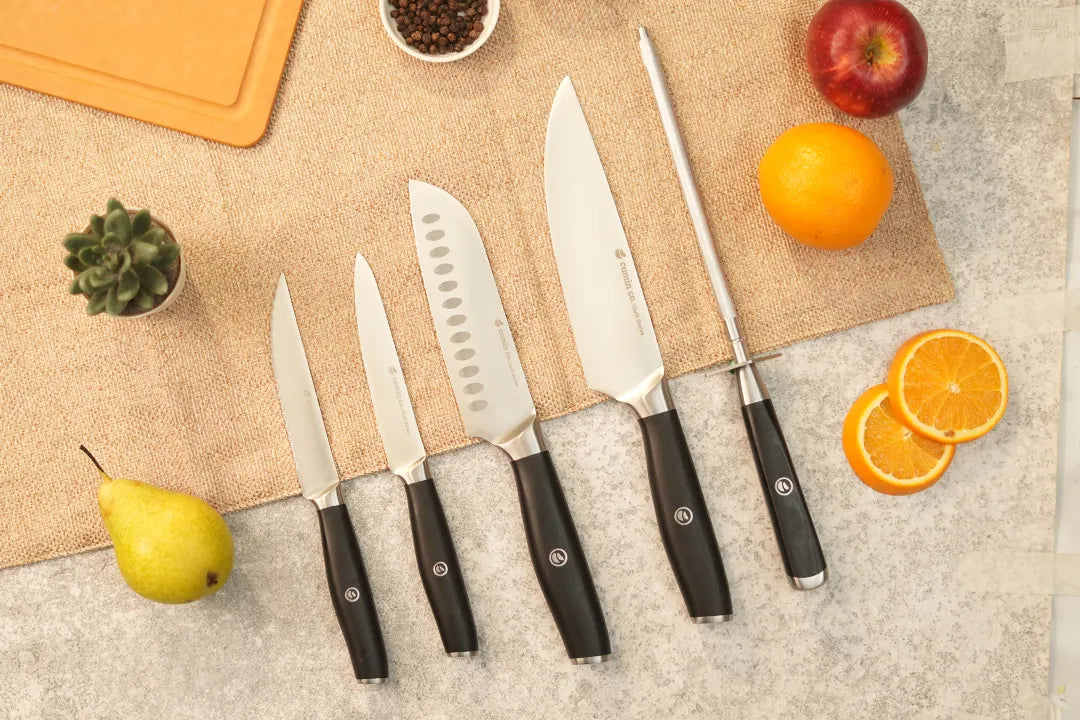
Suitable blade: Chef’s Knife or Santoku
2. Dicing — the cube method (types of chopping)
The technique: Start with even slices, stack them into strips, then cut across into cubes. It’s a simple system, but precision matters at every step.
The sizes:
-
Large Dice: ¾ inch — slow-cooked dishes
-
Medium Dice: ½ inch — everyday soups and curries
-
Small Dice: ¼ inch — sauces and bases
-
Brunoise: ⅛ inch — fine finishing work
Why it matters: When everything is the same size, everything cooks the same way. No surprises in the pan.
Suitable blade: Chef’s Knife
3. Julienne — matchstick cuts
The technique: Square the vegetable, slice it into thin planks, stack them, and cut into fine, even sticks.
Best for: Carrots, zucchini, peppers.
Why it matters: Thin, even cuts cook quickly and hold texture better under high heat.
Suitable blade: Santoku Knife
4. Chiffonade — herb ribbons
The technique: Stack the leaves, roll them tight, and slice across into fine ribbons. Keep it light — no crushing.
Best for: Basil, mint, spinach, kale.
Why it matters: Keeps herbs fresh, aromatic, and clean in presentation.
Suitable blade: Chef’s Knife
5. Mincing — fine breakdown
The technique: Rock the knife over the ingredient, using the tip as your pivot. Keep going until it breaks down completely.
Best for: Garlic, ginger, shallots.
Why it matters: The finer it gets, the more it disappears into the dish — flavour without texture.
Suitable blade: Chef’s Knife
6. Chopping — the loose cut
The technique: No strict geometry here. Just consistent, manageable pieces. Keep it controlled, not perfect.
Best for: Stocks, stews, roasted vegetables.
Why it matters: Some dishes don’t need precision — they need character and even cooking.
Suitable blade: Chef’s Knife
7. Bias cut — angled slicing
The technique: Instead of cutting straight down, angle the blade and slice across. It’s a small shift that changes everything.
Best for: Spring onions, celery, asparagus.
Why it matters: More surface area means faster cooking and better sauce absorption.
Suitable blade: Chef’s Knife or Santoku
8. Batonnet — structured sticks
The technique: Cut into even sticks, around 6mm thick. Everything starts here if you’re building toward a dice.
Best for: Potatoes, carrots, parsnips.
Why it matters: It’s the base measurement cut — once this is right, everything after is easier.
Suitable blade: Chef’s Knife
9. Tourné — the shaped cut
The technique: A slow, controlled carve that turns root vegetables into smooth, seven-sided shapes. It’s all hand control and patience.
Best for: Potatoes, turnips.
Why it matters: More about precision than practicality — used when presentation matters as much as cooking.
Suitable blade: Utility Knife
Types of Meat Cuts — working with muscle
Meat isn’t like vegetables. It has direction, structure and grain. If you ignore that, you lose texture instantly.
Slicing cooked meat (roasts, grilled meats, turkey)
The technique: One clean pull through the meat. No sawing. No back-and-forth motion.
Why it matters: Sawing breaks the fibres and pulls out the juices you want to keep inside.
Suitable blade: Chef’s Knife
Slicing raw meat and fish (against the grain)
The technique: Always cut across the grain, not along it. Short strokes that break fibre length.
Why it matters: This is what keeps meat tender after cooking.
Suitable blade: Santoku Knife
Trimming fat and portioning
The technique: Small, controlled cuts along fat lines, bone edges, and silver skin. Slow and deliberate.
Why it matters: Clean separation without wasting usable meat.
Suitable blade: Utility Knife
Table slicing cooked meat
The technique: Even slices, about ¾ inch thick, cut cleanly in one motion.
Why it matters: A clean cut keeps the crust intact and the inside juicy.
Suitable blade: Steak Knife
Knives for different types of cut: A quick reference matrix
To eliminate confusion regarding different styles of kitchen knives, use this strict tool-to-task allocation guide:
|
Cutting Task |
Best Kitchen Blade |
Mechanical Reason |
|
Slicing, Chopping, Mincing |
Long blade with a curved belly designed for continuous rocking cuts. |
|
|
Julienne, Fine Slicing, Raw Fish |
Flat edge profile optimized for vertical, up-and-down push-cutting. |
|
|
Trimming, Tournée, Detail Work |
Narrow, short blade providing maximum tip control in tight spaces. |
|
|
Table Carving, Cooked Proteins |
Razor-sharp straight edge that cleaves meat cleanly without tearing. |
Why does high-carbon stainless steel dictate edge performance?
A knife can only perform as well as the steel it’s made from. That’s what ultimately defines how different types of cooking knives behave in real kitchen use, and how reliably cutting methods hold up under pressure.
With softer steel, the edge breaks down quickly. Once that happens, even basic cutting techniques stop behaving cleanly — you get slipping, crushed surfaces, and uneven cuts instead of controlled precision. A lot of everyday cutting methods vegetable prep depends on becoming harder to execute consistently.
High-carbon stainless steel solves this by holding a sharper, more stable edge for longer. That stability is what supports real knife skills, especially when you're repeating the same motions across large volumes of ingredients.
In vegetable-heavy prep, this shows up across all cutting techniques vegetables require — slicing, dicing, and fine chopping. The blade stays predictable, cuts stay clean, and control doesn’t fade halfway through prep.
Professional cutting tips to live by
-
Let the blade do the work — never force it down: If you must apply heavy physical pressure, your knife is blunt. A sharp blade cuts cleanly through the food using nothing more than its own weight.
-
Never cut in mid-air — anchor your board: Slicing ingredients over an open hand is a foolish risk. Work exclusively on a flat cutting board locked in place with a damp cloth.
-
Align the tool to the ingredient structure: Respect the engineering of your blades. Do not use a delicate Santoku on heavy bone, and do not use a massive Chef's knife for intricate paring work.
-
A dull blade is your greatest hazard: When an edge loses its sharpness, it slides unpredictably off slick surfaces like onion skins or winter squash, veering directly toward your guiding hand.
-
Enforce mise en place discipline: Execute all your washing, peeling, and chopping before you turn on the heat. Attempting to chop ingredients mid-cook introduces chaos and causes uneven cooking.
-
Insist on absolute geometric uniformity: Size dictates cooking speed. Ensure your dices and slices match perfectly so every element in your pan cooks at the exact same rate.
-
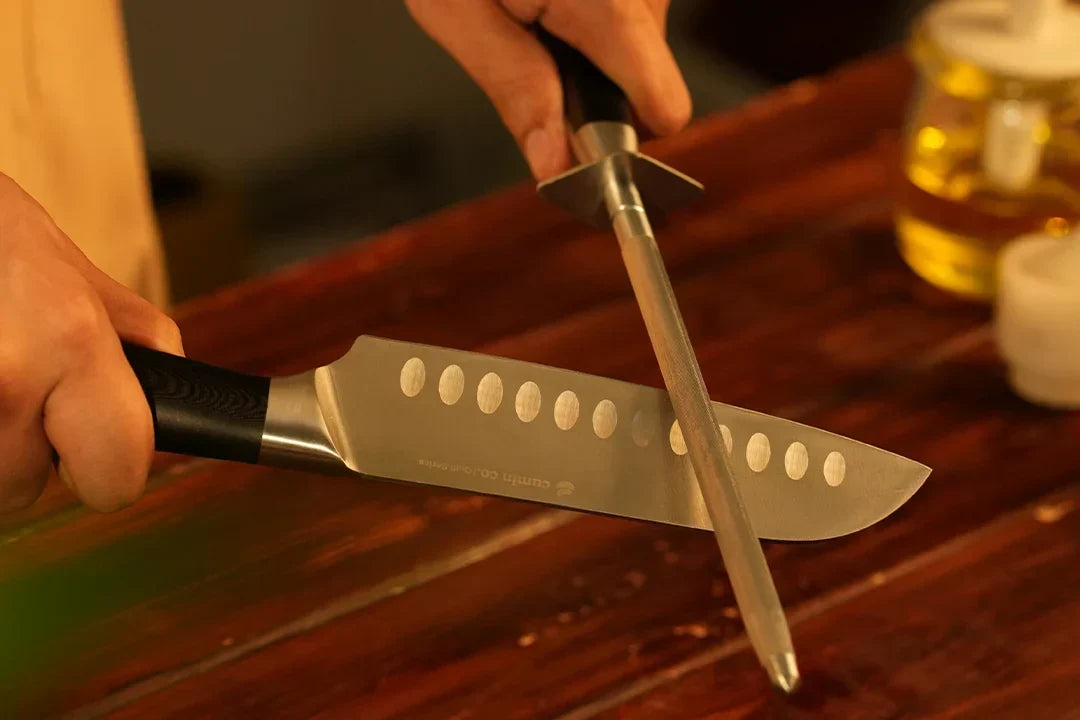
Store your edges in isolation: Throwing premium knives naked into a cluttered drawer destroys the edge instantly. Protect your blades using a dedicated magnetic strip, an in-drawer organizer, or a secure knife stand.
FAQs about knife skills and cutting techniques
What is the difference between chopping and dicing?
Chopping is loose and uneven, used when shape doesn’t really matter. Dicing is more controlled — you cut ingredients into even cubes so they cook at the same rate. Both are basic knife skills with a chef’s knife, just used with different levels of precision.
Which knife is best for cutting vegetables?
A chef’s knife works for most vegetable prep. A santoku is better when you want cleaner, finer cuts like thin slices or julienne. A utility knife is useful for smaller jobs where you need more control than force.
How do I improve my knife skills at home?
Start with how you hold the knife and how steady your cuts are. Go slow until everything looks even, then build speed over time. The main thing is consistency — the more controlled your cutting techniques become, the more natural it all feels.