 Food Containers
 Cookware Sets
 Limited Edition Launches
 Bakeware
 Serveware
 Corporate Gifting


Stainless steel of AISI 304 grade or higher is the safest pressure cooker material for everyday Indian cooking. It doesn't react with acidic food like tamarind, tomato and kokum. Hard anodised aluminium is fine as long as its oxide layer is intact, but once that layer wears through, you're cooking on bare aluminium. Plain aluminium reacts the most of the three, so it's best kept away from long or acidic cooking.
That's the short answer, and it's what most people come here for. But "safe" needs a little more explaining. Aluminium isn't poisonous. Stainless steel isn't completely inert either. And the biggest safety factor in an Indian kitchen isn't the metal at all. It's whether your cooker carries a valid ISI mark and is designed in a way that keeps your kitchen in mind.
This blog goes through all three materials with real data. You'll see the limits set by regulators, what leaching studies found, the Indian safety standard that became mandatory in 2021, and what each material asks you to put up with.
What Are Pressure Cookers Made Of? The Three Materials Explained
Almost every home/domestic pressure cooker sold in India is made from one of three materials. They conduct heat differently, they react with food differently, and they wear out differently.
Aluminium Pressure Cooker: Light, Fast and Chemically Reactive
Aluminium carries heat at around 205 to 237 W/m·K. That's roughly thirteen to fifteen times better than stainless steel. It's why an aluminium cooker heats up fast, reaches pressure quickly and costs the least. It's also light, which helps when the cooker is full and you're lifting it off a gas burner.
The catch is chemistry. Aluminium dissolves in both acids and alkalis. In open air it grows a thin oxide film on its own, but that film is only a few nanometres thick and acid eats through it easily. So tamarind, tomato, lemon, kokum, vinegar and salty gravies all pull some aluminium into your food. The longer the contact and the hotter the pot, the more comes out.
Stainless Steel Pressure Cooker: Inert, Heavy and Long-Lasting
Stainless steel is an alloy. The usual grade is AISI 304, which has around 18% chromium and 8% nickel. Some cookers use 316 for extra corrosion resistance. The chromium is what makes it "stainless". It forms a thin chromium-oxide layer on the surface, and that layer repairs itself. Scratch it and it forms again within minutes once it meets oxygen. This is why steel stays non-reactive with acidic food for years, and aluminium can't do the same.
The downside is heat. Stainless steel conducts at only about 16 W/m·K, so on its own it's a poor cooking material. Food burns in hot spots right over the flame. That's why every well-made stainless steel cooker has a sandwich or triply base, with a layer of aluminium (sometimes copper) sealed between steel. The steel touches your food and the aluminium spreads the heat. You get good conduction and an inert surface
Hard Anodised Pressure Cooker: Aluminium With a Hardened Oxide Skin
Hard anodising is often called a coating. It isn't one, and that difference matters for safety.
Anodising is a chemical conversion done with electricity. The aluminium body goes into a chilled bath of sulphuric acid and gets charged with high voltage. This turns the outer layer of the metal itself into a dense film of aluminium oxide. Under the standard for hardcoat anodising, MIL-A-8625 Type III, that layer usually runs 5 to 30 microns thick. About half of it grows into the metal and half builds outward. Since it grows out of the base metal instead of being sprayed on top, it can't chip or peel like a non-stick coating.
The finished oxide is very hard and far less reactive than the bare aluminium under it. It's also fairly non-stick without any PTFE, which is a real plus.
The catch is that hard anodising is a wear layer, not a permanent shield. It's thin, and it behaves like a ceramic, which means hard but brittle. Steel scrubbers, harsh alkaline dishwasher detergent and abrasive powders all thin it out. Once it's broken through, you're cooking on plain aluminium in that spot, and the reactivity problem is back.
Is an Aluminium Pressure Cooker Safe for Daily Indian Cooking?
An aluminium pressure cooker is a poor choice for acidic dishes like sambar, rasam, tomato gravies and tamarind curries. And you should never use it to store cooked food. The worry isn't sudden poisoning. It's the aluminium that builds up in your diet over time.
How Much Aluminium Actually Leaches Into Food?
Two numbers help here.
The first is the regulatory limit. The Council of Europe and EDQM guide on metals used in food contact materials (2nd edition, 2024) sets a specific release limit of 5 mg of aluminium per kilogram of food. European regulators use this as the benchmark for whether a metal food-contact item is acceptable.
The second is what was actually measured. A peer-reviewed study in PLoS ONE (Sander et al., 2018) tested how much aluminium came out of uncoated aluminium food-contact items into real foods and food simulants. When food was cooked, chilled and then held hot, the release went over the 5 mg/kg limit by up to six times. A citric acid solution pulled out about 30 mg/L. Sauerkraut juice reached about 10 mg/kg. Tomato purée peaked near 5 mg/kg. The authors found that low pH was the biggest factor after temperature and contact time.
Now the part most blogs leave out. Those tests used long contact times, not pressure cooking conditions. A pressure cooker runs for five to twenty minutes. That's nothing like a tray of acidic food sitting hot for hours. Short pressure cooking in aluminium releases much less than those headline figures suggest.
The real problem in Indian kitchens is simpler. It's leaving sambar, rasam or a tamarind curry in the aluminium cooker for six hours after cooking. That's exactly the low-pH, long-contact, warm-storage situation the study copied. If you take just one rule from this article, make it that one.
For some context on how much aluminium is too much: in 2011, at its 74th meeting, the FAO/WHO expert committee JECFA set a provisional tolerable weekly intake of 2 mg per kg of body weight. That came from a no-effect level of 30 mg/kg body weight per day with a hundred-fold safety margin. For a 60 kg adult, that's about 120 mg a week. EFSA is stricter. It set 1 mg/kg body weight per week in 2008, and noted that many people in Europe, children especially, may go over it, with high-end intakes of 0.7 to 2.3 mg/kg per week. Cookware is only one source. Cereals, vegetables, tea and food additives add more.
Is a Stainless Steel Pressure Cooker Safe? What the Nickel and Chromium Data Shows?
Yes. Stainless steel is the least reactive of the three materials in everyday use, and the nickel and chromium it releases stays within normal dietary ranges. That’s what makes it safe to use for everyday recipes particularly in Indian kitchens.
Three things that we need to keep in mind from studies conducted to study the amount of Chromium and Nickel leaching from stainless steel pressure cookers.
-
Leaching drops fast with use. The release fell with each cooking cycle and levelled off after about the sixth. A used cooker behaves very differently from a brand-new one.
-
Six hours isn't a pressure cooking cycle. The researchers simmered for a long time on purpose, to make the movement easy to measure. Fifteen minutes under pressure is a small fraction of that.
-
The numbers sit inside normal dietary intake. Most people get about 90 to 361 µg of nickel a day from food alone. An 88 µg addition from a six-hour tomato simmer is within what you already take in from oats, legumes, nuts, chocolate and tea.
The regulatory limits are the EDQM specific release limits, 0.14 mg/kg for nickel and 0.25 mg/kg for chromium. Properly made AISI 304 and 316 food-contact items are tested against them.
There is one real exception. People with a confirmed nickel allergy, or systemic nickel allergy syndrome, should be careful. For them, 18/0 stainless steel (ferritic, with no nickel) or a well-kept enamel surface is more comfortable, and it's worth talking to a doctor instead of a cookware brand. For everyone else, the data gives no reason to avoid AISI 304.
Is a Hard Anodised Pressure Cooker Safe, and What Happens When the Layer Wears?
A hard anodised pressure cooker is safe while the anodised layer is intact. The aluminium oxide surface is much less reactive than bare aluminium, and it can't chip or flake off like a sprayed coating. The real question is how long it lasts. Once the oxide wears through, that spot acts like uncoated aluminium which is something all kitchens should avoid.
Here's what a materials engineer would tell you that most buying guides skip.
-
The layer is thin. Cookware anodising usually sits at the low end of the MIL-A-8625 Type III range. There's no big reserve to lose.
-
Alkaline detergent is the main enemy. High-pH cleaners attack aluminium oxide. That's why almost every hard anodised cooker is sold as hand-wash only, and why a "dishwasher safe" claim on one is worth a second look.
-
You can't fix it at home. Anodising needs an acid bath and high-voltage current. Once it's gone, it's gone.
-
Induction is a separate question. Aluminium isn't magnetic and won't work on an induction hob. A hard anodised cooker only works if a steel disc has been bonded to the base. Check for that instead of assuming.
-
Look for warning signs. Dull grey patches, a chalky white bloom, or a metallic taste coming back in acidic dishes mean the oxide is damaged in that area.
Hard anodised is a good material. It beats bare aluminium on every safety point, and it's lighter and cheaper than triply steel. It just has a life span that depends on how you treat it, and buyers should hear that before they buy, not after.
Aluminium vs Stainless Steel vs Hard Anodised Pressure Cooker: Full Comparison
|
Parameter |
Aluminium |
Stainless Steel (AISI 304+) |
Hard Anodised |
|
Reactivity with acidic food |
High, leaches with tamarind, tomato, kokum |
Very low, self-healing passive chromium oxide layer |
Low while intact, high once the layer wears through |
|
Thermal conductivity |
About 205 to 237 W/m·K (fastest) |
About 16 W/m·K (needs a bonded aluminium or triply base) |
Same as aluminium beneath the oxide |
|
Weight (5 L, typical) |
Lightest |
Heaviest |
Medium |
|
Surface durability |
Soft, scratches and pits easily |
Hardest in practical use, scratches are only cosmetic |
Very hard but brittle and finite |
|
Dishwasher |
Not recommended, dulls and pits |
Generally yes |
Generally no, alkaline detergent attacks the oxide |
|
Induction compatible |
Only with a bonded steel base |
Yes (magnetic grade base) |
Only with a bonded steel base |
|
Food storage in the vessel |
Avoid entirely |
Acceptable |
Avoid for acidic food |
|
Typical service life |
Shortest |
Longest, often decades |
Medium, depends on the oxide layer |
|
Best for |
Rice, steaming, plain dal, budget kitchens |
Everyday Indian cooking including acidic gravies |
Low-oil cooking, buyers who want light weight without bare aluminium |
Pressure Cooker Safety Standards in India: IS 2347 and the Mandatory ISI Mark
This is the most important safety point in the whole article, and almost no comparison blog talks about it.
Every home pressure cooker sold in India must carry a valid ISI mark under IS 2347:2023. The Domestic Pressure Cooker (Quality Control) Order, 2020, issued by the Ministry of Commerce and Industry, made BIS certification legally mandatory from 1 February 2021. A cooker without a real ISI mark and licence number isn't a cheaper option. It's a non-compliant product.
Here's what the standard covers.
-
Home cookers from 1 to 22 litres, in inner-lid and outer-lid designs, including induction-compatible bases.
-
Allowed materials: food-grade aluminium alloys and stainless steel of at least AISI 304 grade. This means a cooker sold as "stainless steel" in India already has to meet the 304 minimum. If a seller is vague about the grade, ask for it in writing.
-
Required safety tests: pressure resistance and material strength, safety valve function, gasket release under heat and pressure, leak prevention, and how well the lid lock holds up.
A pressure cooker is a pressure vessel. It runs at roughly 1 bar above normal air pressure, at around 120 °C. The gasket release system and the safety valve are what stand between normal cooking and a serious kitchen accident. A cooker made from the best metal but without certified safety valves is more dangerous than a certified aluminium one. Material safety and mechanical safety are two different questions, and the second one is more urgent.
To check, look for the ISI mark along with the licence number (it looks like CM/L-xxxxxxx) and the IS 2347 reference stamped or moulded on the cooker body. Printing on the carton alone doesn't count. You can also cross-check the licence on the BIS website.
How to Choose a Safe Pressure Cooker: A 6-Point Buying Checklist
-
Check the ISI mark and IS 2347:2023 licence number on the cooker body. This one isn't optional. If you're buying from a marketplace seller, verify the licence on the BIS portal.
-
Ask for the stainless steel grade. AISI 304 is the legal minimum. 316 is better for coastal humidity and heavy acidic cooking. "Food-grade steel" with no number isn't an answer.
-
Look at the base. A single-layer stainless steel cooker will burn food. Look for an encapsulated sandwich base or triply build, and check the base thickness if it's listed.
-
Match the material to what you cook. If your week is full of sambar, rasam, tomato curries and tamarind gravies, go with stainless steel. If it's mostly rice, khichdi and steamed vegetables, aluminium or hard anodised will do and cost less.
-
Check induction compatibility on its own. Don't guess from the material. Aluminium and hard anodised bodies need a bonded steel base.
-
Check that you can buy the gasket and safety valve. These wear out in one to two years of regular use. If you can't get spares five years from now, that's a safety problem, not just an annoyance.
Pressure Cooker Care: Keeping Any Material Safe for Years
The material you pick sets the upper limit. How you care for the cooker decides whether you reach it.
-
Never store cooked food in the cooker, whatever it's made of. This is the habit that makes the biggest difference in this whole guide. Move the food into glass or steel containers once the pressure is gone.
-
Add salt and tamarind late. Put them in when the liquid is already hot and diluted, not into cold water at the start. Strong cold brine is the harshest condition for aluminium and for the protective layer on steel.
-
Keep steel wool and scouring powder off hard anodised surfaces. Use warm water, a soft sponge and a mild detergent. For stuck-on food, soak it instead of scrubbing.
-
Take the gasket out after every use. Wash it separately and let it dry fully. A gasket stored damp and squeezed shut goes hard and loses its shape early.
-
Clear the vent pipe every few weeks. A dry brush or a wooden skewer works. A blocked vent leaves all the safety work to the backup valve.
-
Replace the gasket and safety valve every 12 to 18 months with regular use. Do it sooner if you see cracks, a permanently flat gasket, or steam leaking around the lid rim.
-
Don't heat an empty cooker. It warps aluminium bases, stresses bonded sandwich bases, and can permanently discolour stainless steel.
Where Cumin Co. Stands on Pressure Cooker Material
We build cookware around one idea: the surface that touches your food shouldn't need a chemical coating to behave.
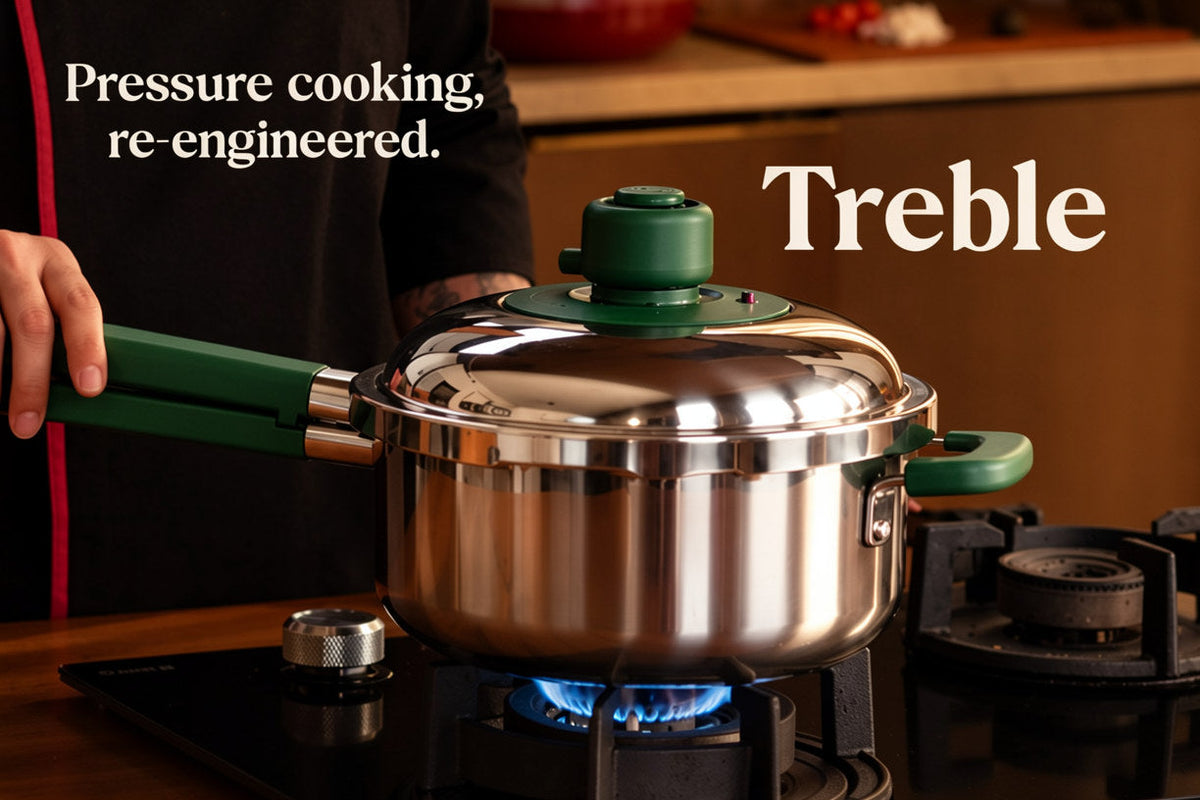
The same thinking points to stainless steel for a pressure cooker. A pressure cooker spends its life full of hot, wet and often acidic food under pressure, which is exactly what punishes a reactive surface. Surgical stainless steel has no coating to wear off, no oxide layer to break through and nothing to redo. That's why the Cumin Co. stainless steel pressure cooker is built the way it is: a surgical stainless steel and triply construction food-contact surface over a heat-spreading bonded base, ISI certified to IS 2347:2023.
We'll also say the part most brands skip. Stainless steel is heavier and costs more than aluminium, and it isn't the right answer for every home. If money is tight and you mostly cook rice and plain dal, a certified aluminium cooker used sensibly is a fair buy. That means no acidic storage and no long simmers. We'd rather you buy a certified cooker in any material than an uncertified one from us.
Explore the Cumin Co. stainless steel pressure cooker
Setting up the rest of the kitchen too? Our cookware sets pair enamel cast iron for slow cooking with the steel and cast iron pieces that handle everyday cooking.
Frequently Asked Questions
Which pressure cooker material is safest for health? Stainless steel of AISI 304 grade or surgical stainless steel is the safest for general use. It doesn't react with acidic food and has no coating that can wear away. Treble by Cumin Co. , made with surgical stainless steel is one of the safest options when it comes to pressure cooking.
Is an aluminium pressure cooker harmful? Not for short, non-acidic cooking like rice or plain dal. It does release aluminium into acidic food like tamarind, tomato and kokum dishes. The main risk is leaving cooked acidic food in the cooker, which gives the food more time in contact with the metal at low pH.
Does a stainless steel pressure cooker leach nickel into food? It might release small amounts of nickel and chromium, but they fall within normal dietary ranges and drop sharply after the first few uses. A 2013 study in the Journal of Agricultural and Food Chemistry measured about 88 µg of nickel in a 126 g serving after six hours of tomato sauce simmering. Typical daily nickel intake from food alone is 90 to 361 µg.
Is a hard anodised pressure cooker safe? Yes, while the anodised layer is intact. The aluminium oxide surface grows out of the metal itself, so it can't chip or peel. If the layer wears through from hard scrubbing or alkaline dishwasher detergent, that spot reacts with acidic food like bare aluminium.
Can a hard anodised pressure cooker go in the dishwasher? No. Most are hand-wash only, because the high-pH detergents in dishwashers attack the aluminium oxide and thin it over time. Wash with warm water, a mild detergent and a soft sponge.
Is the ISI mark compulsory for pressure cookers in India? Yes. The Domestic Pressure Cooker (Quality Control) Order, 2020 made BIS certification to IS 2347:2023 mandatory for all home pressure cookers sold in India from 1 February 2021. Look for the ISI mark and licence number on the cooker body, not just on the box.
Which pressure cooker material is best for Indian cooking with tamarind and tomato? Stainless steel. Acidity is the main thing that pushes metal into food, and stainless steel stands up to acid. Aluminium is the weakest choice for these dishes.
How often should I replace the gasket and safety valve? Every 12 to 18 months with regular daily use. Change them sooner if you see cracks, a gasket that has gone permanently flat, or steam escaping from the lid rim while cooking. They're wear parts, not lifetime ones.