 Shop All
 Food Containers
 Cookware Sets
 Limited Edition Launches
 Bakeware
 Serveware
 Corporate Gifting


People have started paying a lot more attention to cookware materials recently. Honestly, it was probably overdue.
For years, most of us bought cookware based on convenience. Whatever looked non-stick, lightweight, easy to clean, and affordable usually won.
Very few people stopped to think about what repeated high heat, scratched coatings, aggressive scrubbing, or daily cooking actually does to those surfaces over time.
Now suddenly terms like PFOA-free, PFAS-free, PTFE-free, ceramic-coated, lead-free, toxin-free and Teflon-free are everywhere.
Which sounds helpful at first. Until you realise most people don’t actually know what any of those terms mean.
And cookware brands are not always making it easier.
Some labels only talk about one chemical while staying completely silent about others. Some cookware looks premium but reveals almost nothing about testing standards or coating materials underneath.
That’s where things get confusing very quickly.
The simplest way to think about cookware safety is this: no material is perfect for every cooking style. But some materials stay more stable under repeated heat and long-term daily use than others.
Especially in Indian kitchens where cooking tends to involve:
-
repeated reheating
-
frying
-
tadkas
-
long simmers
-
high flame cooking
And that’s usually where conversations around PFAS, PTFE, PFOA, lead, and cadmium begin.
What Is PFOA in Cookware?
Why Was PFOA Used in Non-Stick Cookware?
PFOA was historically used during the manufacturing of certain non-stick coatings.
Not because consumers specifically wanted it. Mostly because it helped create smooth, slippery coating surfaces during production.
For years, hardly anyone outside the cookware industry paid attention to the term.
Then research and regulatory conversations around long-term chemical exposure started becoming more public.
Is PFOA Still Used Today? What Does “PFOA-Free” Mean?
Many cookware brands today advertise themselves as PFOA- free cookware.
Which simply means PFOA was not intentionally used during manufacturing.
That’s useful. But it also doesn’t automatically mean the cookware is completely free from every other PFAS-related material.
And that’s where people sometimes misunderstand the label.
Understanding PFAS, PTFE & Teflon — What’s the Difference?
What Are PFAS Chemicals?
PFAS refers to a very large family of synthetic chemicals used across different industries.
Cookware is just one part of that conversation.
They became popular partly because they resist heat, oil, stains, and water very effectively.
The downside is that these chemicals also tend to break down very slowly over time.
What Is PTFE?
PTFE is a synthetic polymer commonly used to create non-stick cooking surfaces.
It’s what gives many pans that smooth, low-stick feel people are used to.
A lot of PTFE- free cookware searches today come from people trying to move away from synthetic coating systems entirely.
Is Teflon the Same as PTFE?
Not exactly.
Teflon is a brand name. PTFE is the actual material.
People often use the words interchangeably now, even though technically they aren’t identical terms.
Why Are PFAS Called “Forever Chemicals”?
Mostly because they break down extremely slowly.
That’s what created concern around long-term environmental buildup and repeated exposure conversations.
The concern is rarely about one meal.
It’s usually about repetition. Daily cooking for years inside the same cookware once coatings begin ageing visibly.
Does PFOA-Free Mean PFAS-Free?
No.
A product can technically be PFOA-free while still using other PFAS-related materials.
Which is why people now increasingly look for labels like:
-
PFAS free cookware
-
PFOA PFAS free cookware
Instead of relying on just one claim.
|
Term |
Meaning |
Common Use |
|
PFOA |
Chemical historically used during manufacturing |
Manufacturing process |
|
PFAS |
Large family of synthetic chemicals |
Coatings & industrial materials |
|
PTFE |
Synthetic non-stick polymer |
Cooking surface coating |
|
Teflon |
Brand name for PTFE coatings |
Non-stick cookware |
What Are the Health Risks of PFOA, PFAS, PTFE, Lead & Cadmium?
|
Chemical |
What the Studies say |
Source |
|
PFOA |
In November 2023 the WHO's cancer agency (IARC) reclassified PFOA as carcinogenic to humans (Group 1), who with limited evidence in humans for renal cell and testicular cancer cdc and strong mechanistic evidence (immunosuppression, epigenetic changes). |
IARC / WHO |
|
PFAS (family) |
The US EPA links exposure to increased cholesterol, reduced immune and vaccine response, interference with natural hormones, developmental effects in children such as low birth weight, and increased risk of some cancers including kidney and testicular. US EPA |
EPA |
|
PTFE / Teflon |
Inert at room temperature, but the coating begins to break down when overheated — PTFE releases fumes at temperatures as low as 260°C (500°F), though human symptoms generally don't start until it is heated to around 350°C, NCBI and inhaling these decomposition products can cause "polymer fume fever" (Teflon flu), a temporary flu-like illness. The fumes can be fatal to pet birds. Poison Control |
NCBI StatPearls / Poison Control |
|
Lead |
From poorly formulated or fired glazes, lead can leach into food, especially acidic food; FDA the FDA sets enforced action levels for leachable lead in foodware. |
FDA |
|
Cadmium |
The FDA states that pottery with cadmium-based pigments FDA may leach cadmium into foods, and that ceramic ware can contain extractable cadmium that acidic foods release, potentially causing chronic cadmium poisoning under continued food use. FDA The FDA enforces leach limits under Compliance Policy Guide Sec. 545.400; California Prop 65 also regulates cadmium. |
FDA (CPG 545.400) |
Why Are People Avoiding PFAS & Teflon Cookware?
A. Concerns Around Overheated Non-Stick Coatings
Most cookware performs reasonably well when used exactly as intended.
Real kitchens are different.
Pans get overheated accidentally. Oil smokes. People forget empty pans on the stove for too long.
And that’s usually when concerns around coating stability start entering the conversation.
B. Potential Long-Term Chemical Exposure
For many people, the concern is less dramatic and more cumulative.
Not “is this dangerous immediately?”
More:
“What happens after cooking in this every day for years once the surface visibly starts ageing?”
That shift in thinking is why more people now specifically search for teflon free cookware and cookware without pfas.
Why Scratched Non-Stick Pans Raise Concerns?
Almost everybody has owned at least one pan that reached that awkward in-between stage.
Not fully damaged.
But not something you feel particularly confident using anymore either.
Tiny scratches near the middle. Edges looking worn. Food sticking in patches where it never used to before.
That’s usually the point where people begin reconsidering long-term cookware choices altogether.
Why Lead and Cadmium Are Used in Some Cookware
Lead and cadmium used to show up quite a bit in decorative glazes and pigments, especially in cheaper cookware production years ago.
Which is also why people now pay closer attention to terms like lead free cookware and cadmium free cookware instead of assuming every enamel pan is automatically safe.
A bright finish alone doesn’t really tell you much anymore.
Risks of Poor-Quality Glazes and Coatings
Two enamel pans can look almost identical on a website.
Completely different standards underneath.
That’s the uncomfortable part most people realise only later. Good cookware usually comes with proper testing disclosures. Cheap cookware mostly comes with adjectives.
And honestly, once you start noticing that difference, it becomes difficult to unsee.
How to Choose Lead-Free Cookware
The brands worth trusting are usually the ones explaining things plainly instead of hiding behind marketing phrases.
You want actual disclosures.
Testing standards. Material information. Clear answers about what the cookware contains and what it doesn’t.
If everything sounds polished but nothing sounds specific, that itself is useful information.
Is Enamel Cookware Lead and Cadmium Free?
Not automatically.
Good enamel cookware should be properly tested for heavy metals.
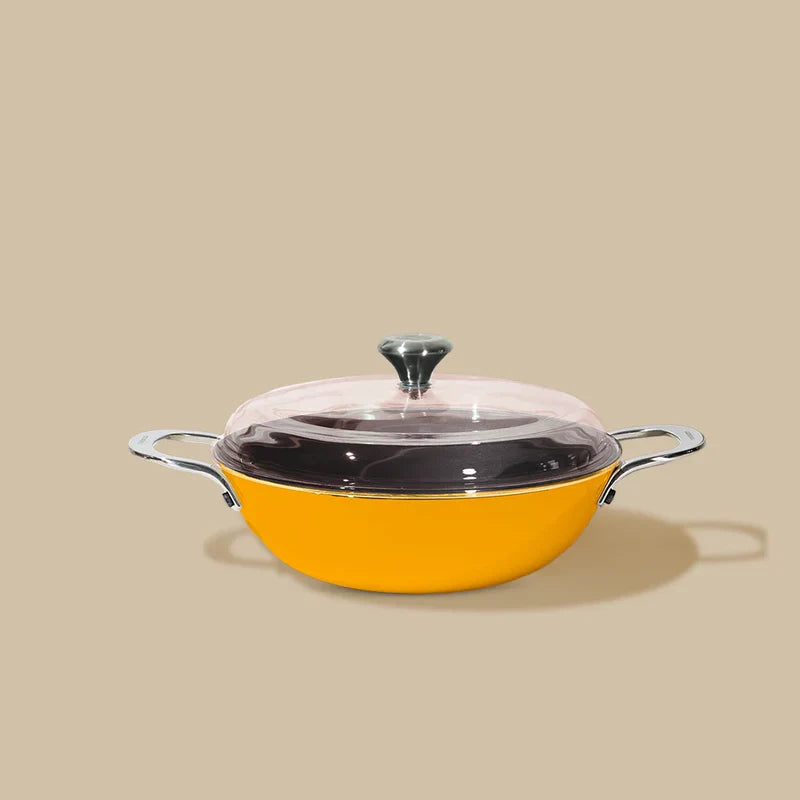
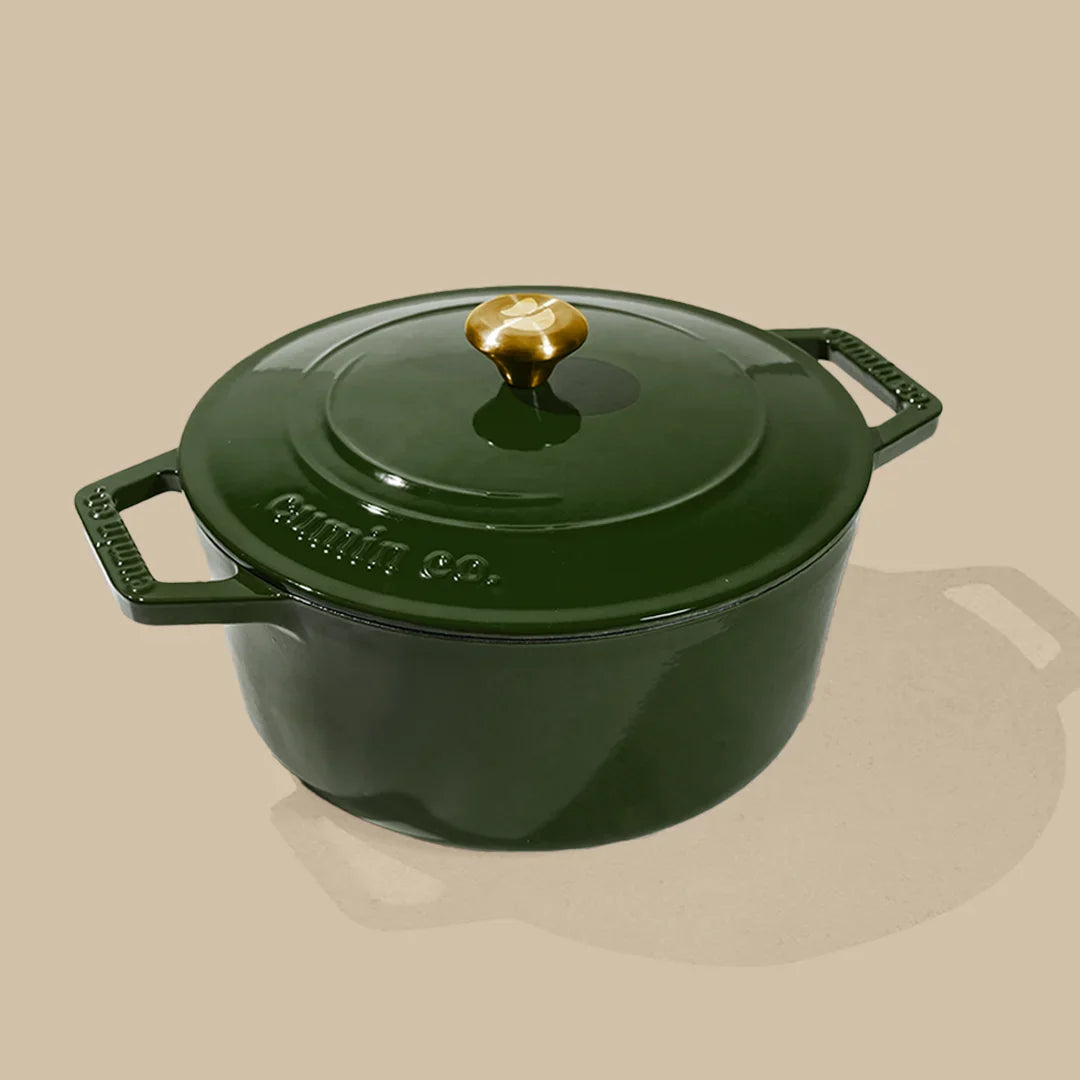
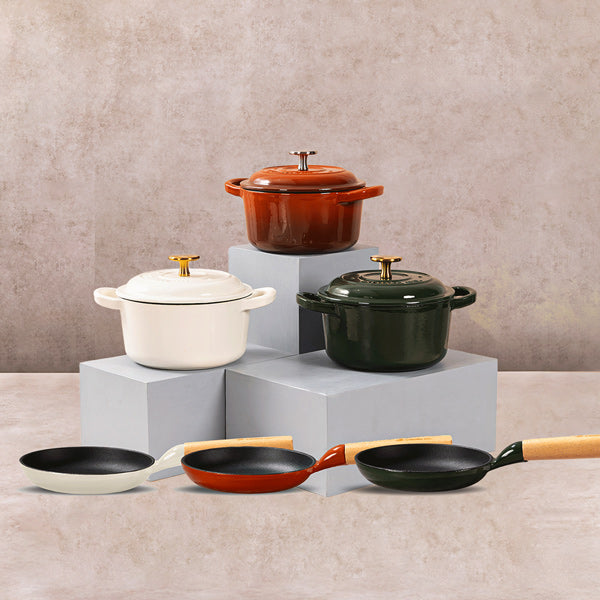
At Cumin Co., the enamel cast iron cookware is free from PFOA, PTFE, lead, and cadmium, and complies with FDA, LFGB and EC 1935:2004 standards.
What are Our Best Types of Non-Toxic Enamel Cookware?
A lot of people moving away from traditional non-stick cookware are not trying to become “serious chefs.”
Usually they just want cookware that feels dependable after years of use.
Especially in Indian kitchens where cooking tends to involve higher heat, longer cooking times, repeated tadkas, and daily use instead of occasional weekend meals.
That’s partly why enamel-coated cast iron has started feeling relevant again.
At Cumin Co., the focus has been on cookware that can handle that kind of everyday cooking comfortably:
Cookware that feels reassuringly stable once it’s on the stove.
How to Identify Truly Safe Cookware
A. Certifications and Safety Standards
The safer cookware brands usually make testing information easy to find.
Not buried six clicks deep.
Things like FDA compliance, LFGB testing, and material disclosures should ideally be stated clearly instead of hidden behind vague phrases about “healthy cooking technology.”
Because cookware safety shouldn’t feel like decoding fine print.
B. Red Flags to Avoid
Very cheap cookware with dramatic claims and almost no technical information deserves a second look.
Same with brands that keep repeating one safety term loudly while avoiding every obvious follow-up question.
Sometimes what a brand avoids saying tells you more than the headline on the box.
C. Questions to Ask Before Buying Cookware
Before buying cookware now, most people probably ask very different questions than they did a few years ago.
Not just “does food stick?”
More like:
-
What exactly is the coating made of?
-
Is it only PFOA-free or fully PFAS PFOA and PTFE free cookware?
-
Has the enamel actually been tested for heavy metals?
-
How does the cookware behave after years of regular high-heat cooking?
Because most people aren’t looking for perfect cookware anymore.
They’re mostly looking for cookware they won’t keep second-guessing.
FAQs
What does PFOA-free cookware mean?
Usually it just means PFOA wasn’t used during manufacturing.
But that alone doesn’t automatically answer every other question about coatings or PFAS-related materials.
Is PTFE-free cookware better?
Depends on what makes you comfortable.
Some people are perfectly fine using non-stick cookware carefully. Others simply prefer avoiding synthetic coatings altogether for daily cooking, especially at high heat.
Is Teflon cookware safe?
Most modern Teflon cookware is considered safe when used properly.
The hesitation usually begins later, once the surface starts looking worn, scratched, or uneven after years of regular use.
What cookware is free from PFAS?
People trying to reduce PFAS exposure often move toward enamel-coated cast iron, stainless steel, or traditional cast iron cookware instead of synthetic non-stick coatings.
Is ceramic cookware lead and cadmium free?
Not always.
Some ceramic cookware is tested properly and some isn’t. Which is why checking brand disclosures matters far more than relying only on appearance or marketing language.
What is the safest cookware for daily use?
There probably isn’t one perfect answer for everybody.
But cookware materials like stainless steel and enamel-coated cast iron are often preferred because they stay stable through years of repeated cooking without relying on delicate synthetic coatings.
Does non-stick cookware contain PFAS?
A lot of traditional non-stick cookware still uses PFAS-related materials somewhere within the coating system.
That’s why more people now specifically search for alternatives like pfas free cookware or cookware without pfas before buying.